


If the first half of the twentieth century was the era of establishing and conquering international markets, the second half marked Mondia's entry into an almost futuristic dimension.
The 60s and 70s were not just a change in style, but a true engineering revolution that would lead the Rue Jardinière brand to interact with the giants of global watchmaking. In this context, the brand's visual identity underwent a radical metamorphosis: the 1960s logo abandoned the reassuring curves of the past to become minimalist, geometric, and orbital, reflecting an era that looked to the stars and space conquest.

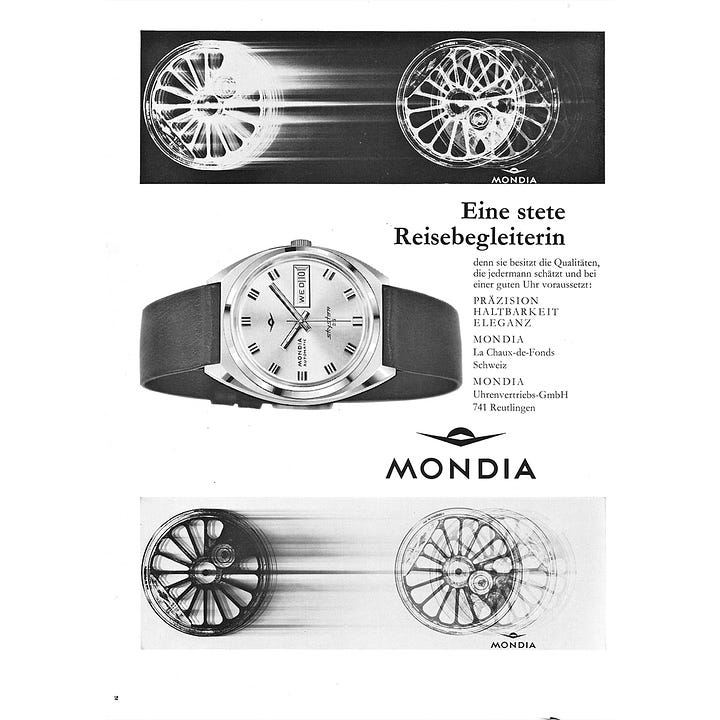
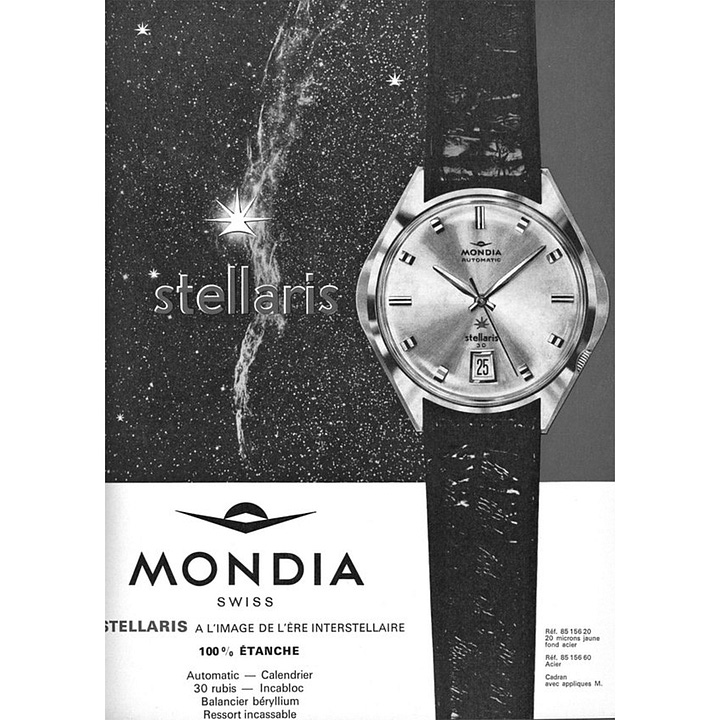
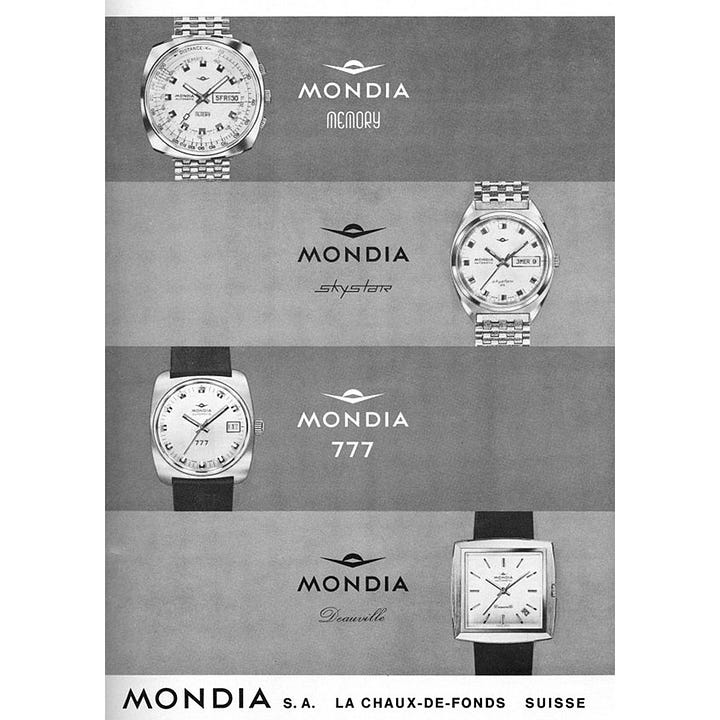
Photo 1: Mondia Logo, used since 1960 – Photo 2: Advertising poster, 1968 – Photo 3: Advertising poster, 1964 – Photo 4: Advertising poster, 1969
Beyond the Mark: The Technical Manufacturing Specification
In this analysis, a fundamental methodological note is needed to clarify the perspective of those who experience watchmaking from the inside. For the author, and for those who have lived the reality of the factory daily, speaking of "marks" or simple graphics is reductive, almost improper. In Mondia's original manufacturing nomenclature, the brand on the dial was not an aesthetic flourish, but a technical specification. Changing the typeface, removing the globe, or adding a geometric symbol meant declaring to the world a change in engineering pace. Each evolution of the Mondia name on the dial corresponded to the launch of a new case technology or a cutting-edge caliber: it was the seal that certified the transition from the classicism of the 1950s to the experimental audacity that would characterize the MZM period.
The Heart of the Archival Fund: The Enigma of the Top Second
The narrative core of this phase lies in the documents concerning the development of the Top Second, perhaps the most iconic and mysterious watch ever produced by the brand. Thanks to an in-depth study of the Paul Vermot Archival Fund at the MIH, we have been able to reconstruct the genesis of this icon. Documents dated April 10, 1970 reveal extensive correspondence between Mondia's technical management and the specialist watchmaker X. Theurillat.
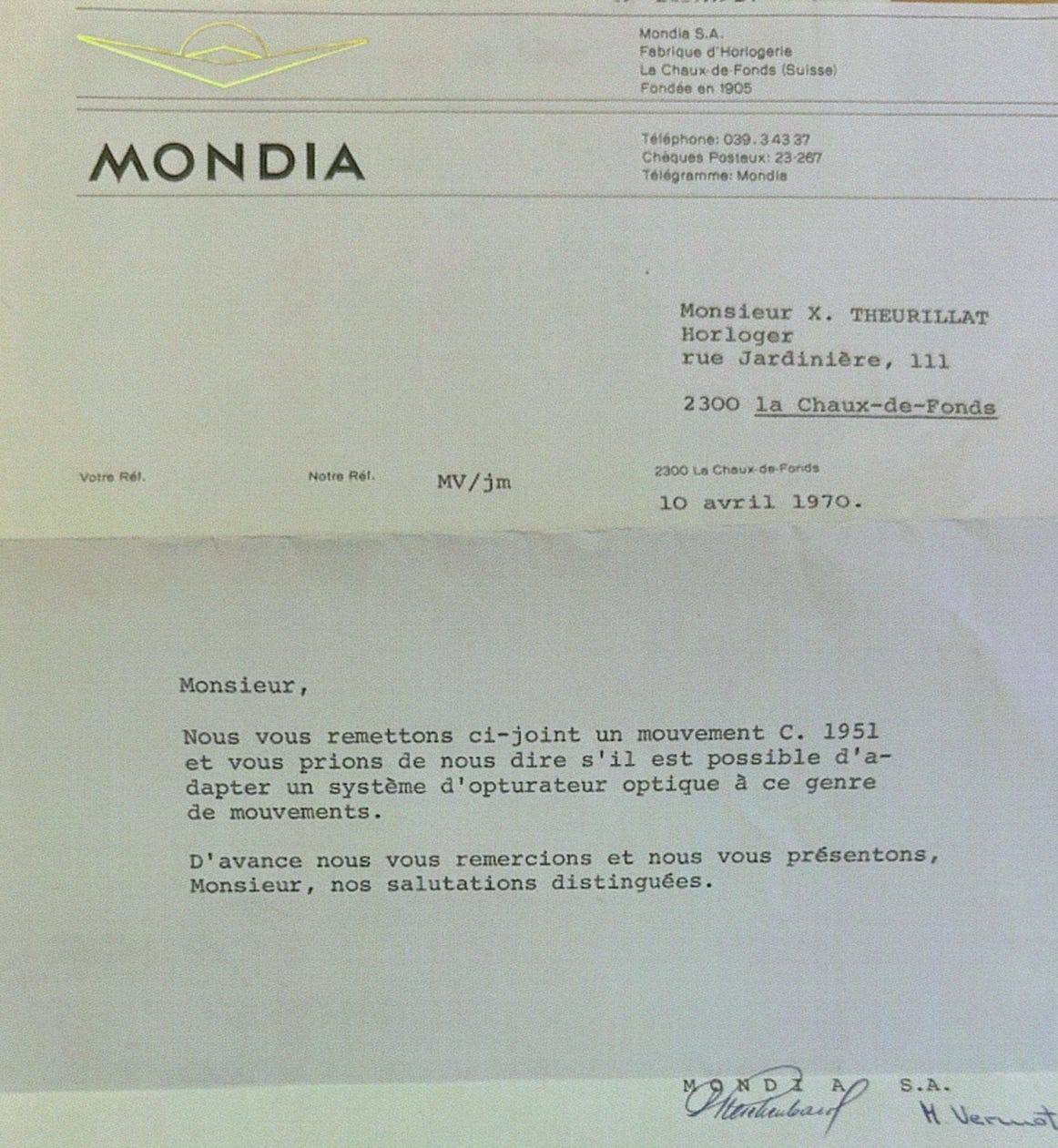
Technical document, Mondia–Theurillat, April 10, 1970
The challenge was to adapt an "optical shutter" (obturateur optique) to the AS 1951 caliber. Paul Vermot's objective was ambitious: he wanted to create a "living" dial, where a flashing dot at 6 o'clock visually synchronized the beat of the balance wheel. It was not a simple visual gimmick, but a challenge to the perception of time. The seriousness of this research is evidenced by amplitude graphs and laboratory tests aimed at ensuring that the addition of the rotating disk did not affect timekeeping accuracy.
Mondia protected this insight with determination, as confirmed by Japanese Patent Application No. 49,433/70: the company did not just follow trends, but created them through pure engineering, challenging the giants of the Land of the Rising Sun on their own turf.
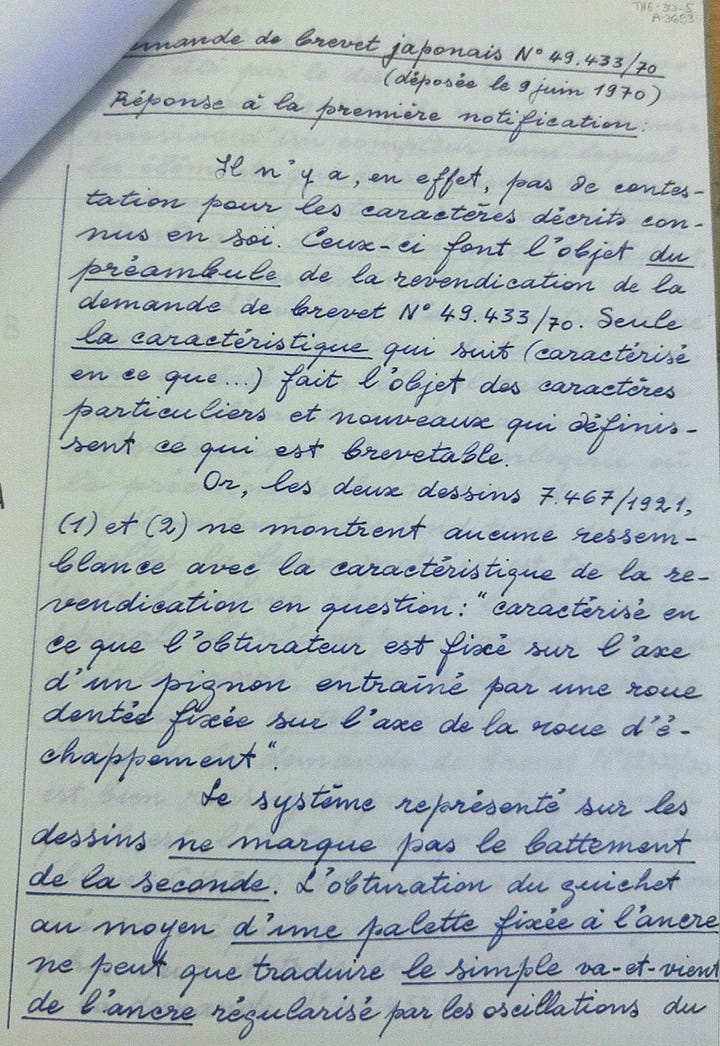
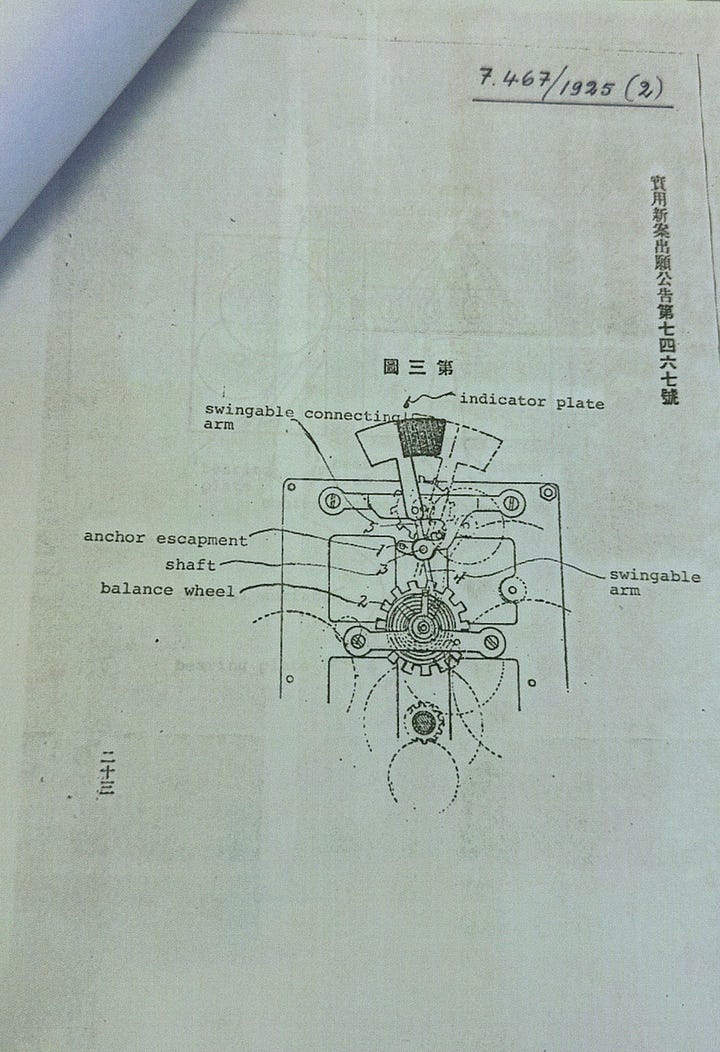
Patent no. 49,433/70 – Mondia (Japan)
The Union with the Giants: The MZM Group
The technical prestige accumulated over decades of research led Mondia, in 1971, to take the definitive step towards the horological elite: the union with Zenith and Movado in the MZM (Movado-Zenith-Mondia) group. As stated in period interviews preserved in the archives, Mondia's integration was considered strategic for its ability to innovate quickly and for its dynamic style. During these years, masterpieces such as the Stellaris and the Moonstone were created, pieces that are now proudly cataloged in the MIH collections. Mondia was no longer a "small" manufacture, but the creative and avant-garde arm of a global giant.
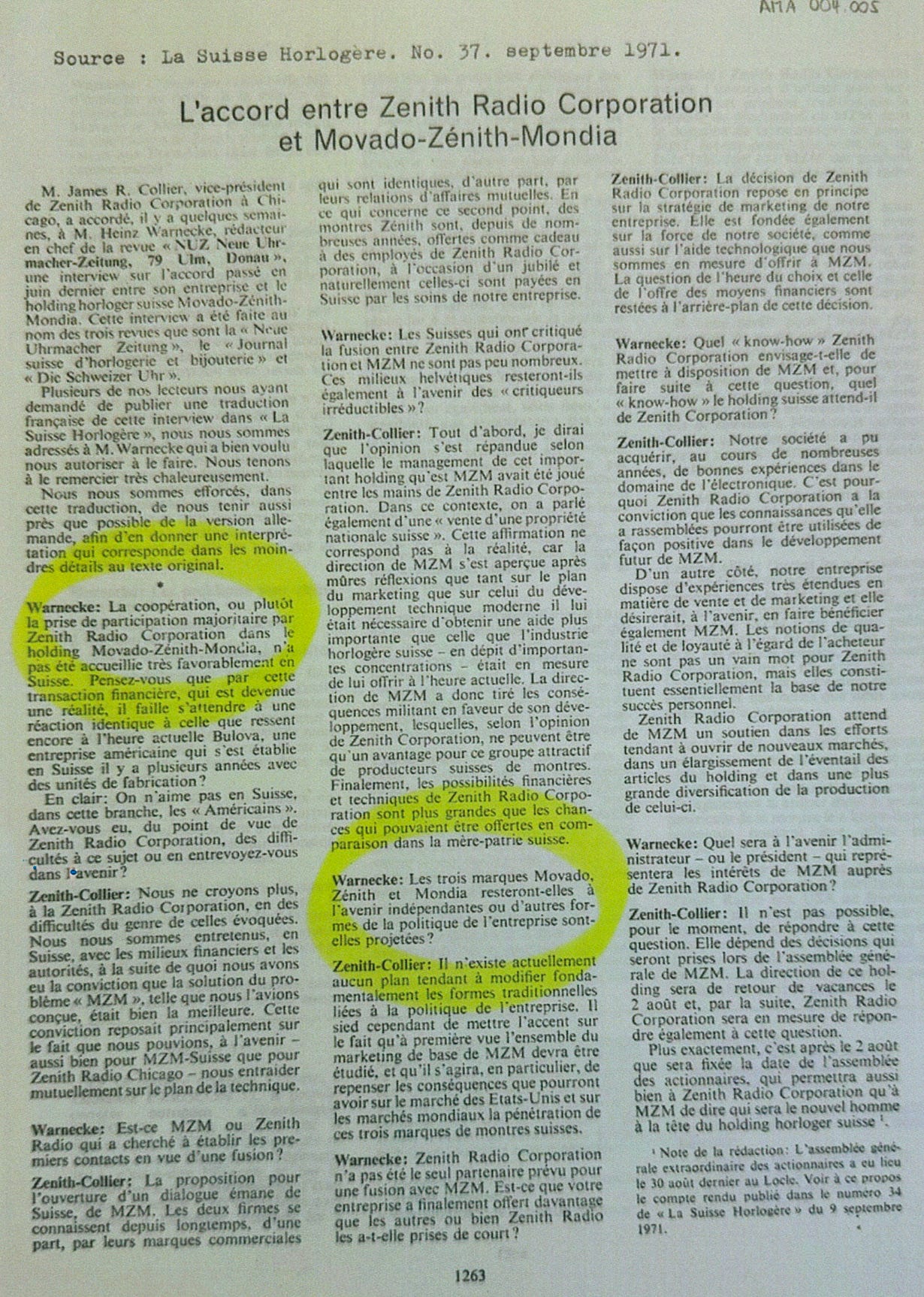
La Suisse Horlogère, No. 37, September 1971 – Archival document
Resistance and Transition: The Years of Italian Ownership
Mondia's contemporary history then goes through a phase of necessary resilience. The previous Italian ownership managed the brand during an extremely complex period for mid-range Swiss watchmaking. In those years of sector crisis, the strategy was to defend the brand: to ensure Mondia's survival, the offering was diversified with the introduction of sub-brands and cheaper products, often not "Swiss Made." This transition, though far from the rigor of its origins, was crucial: it allowed the Mondia name to avoid disappearing from the market and to maintain its recognition, paving the way for the definitive leap in quality.
2025: The Giglio Family and the Return to Swiss Made
The real turning point came in 2025, with Mondia's transfer to Diffusione Orologi, a company owned by the Giglio Family. With a history in the sector spanning over three generations, the Giglio family didn't just acquire a brand; they initiated a "historical restoration" and repositioning operation of excellence. Their vision is a radical and uncompromising return to the Swiss origins of the manufacture.
The tangible sign of this new era is the 2025 logo, which proudly introduces the word SWISS under the Mondia name. It is not just a label, but a declaration of intent. The ownership acted as a true "historical curator," physically returning to the MIH to study the Paul Vermot Archival Fund. Recovering those documents meant being able to look the founder in the eye and bring his technical challenges back to life with absolute fidelity. This direct link with the archives in La Chaux-de-Fonds is what allows Mondia today, under the guidance of the Giglio family, to be a brand with a real, documented, and once again proudly Swiss Made soul.

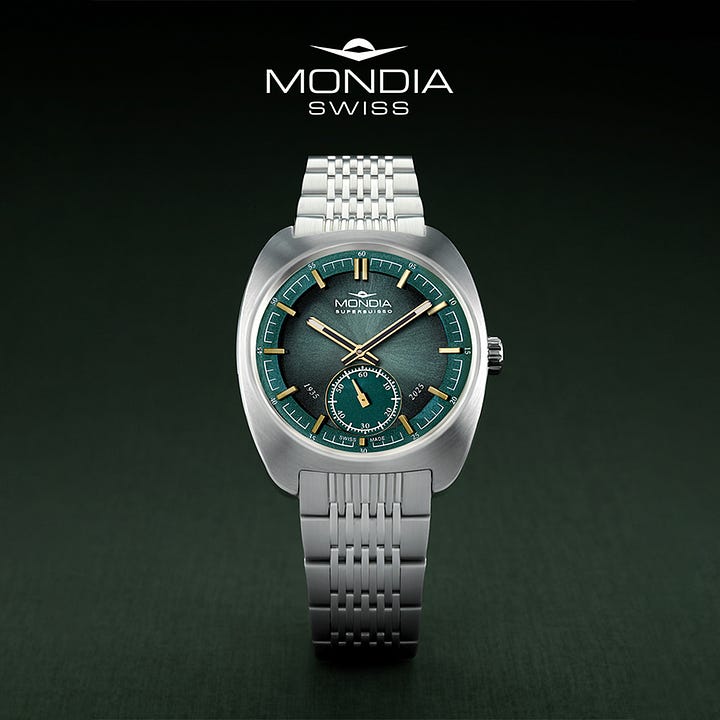
Photo 1: Mondia Logo, 2025 – Photo 2: Advertising poster, 2026
Conclusion: A Future Written in the Past
Wearing a Mondia today means owning a piece of that "Supersuisse" vision that defied time. The current visual identity is not a mere exercise in modern style; it is a synthesis that honors the rigor of 1905 and the geometry of the 1970s, filtered through the aesthetic sensibility of those who have lived watchmaking for generations.
The journey that began in 1905 on Rue Jardinière continues. From Paul Vermot's first "Vision of the Name" to the "Technical Specification" of the Top Second, to today's Swiss rebirth, Mondia remains true to itself: independent in spirit, Swiss in rigor, and Italian in passion and entrepreneurial vision. The circle closes, but the path to the centenary is already traced in those original notes that, after ninety years, continue to tell us that time is something to be interpreted with audacity.
Recommend Mondia Swiss to enthusiasts like you — Mondia Swiss is the place for those who love time and watches. Here, enthusiasts and curious minds can discover stories, details, and inspirations, and share their passion for watchmaking. Join us and bring your fellow enthusiasts: let's explore the world of Mondia together.
🇬🇧 Inside the Time: The Evolution of Identity (Part 1: 1935 - 1958)
🇬🇧 Mondia "Archive Series": The Centennial Decade Begins with an Archival Sheet